I Know You Hear the Music Getting Louder Nowthe Fear Your Heart Beat Is Beating Faster Now
Palpitations are feelings or sensations that your heart is pounding or racing. They tin can exist felt in your chest, throat, or neck.
You may:
- Accept an unpleasant awareness of your own heartbeat
- Experience like your middle skipped or stopped beats
The heart's rhythm may be normal or abnormal when y'all accept palpitations.
Normally the heart beats 60 to 100 times per minute. The rate may drop below threescore beats per minute in people who exercise routinely or take medicines that slow the heart.
If your heart rate is fast (over 100 beats per minute), this is called tachycardia. A heart charge per unit slower than 60 is called bradycardia. An occasional extra heartbeat out of rhythm is known equally extrasystole.
Palpitations are not serious nearly of the time. Sensations representing an abnormal centre rhythm (arrhythmia) may be more serious.
The following conditions brand you more likely to have an abnormal heart rhythm:
- Known center disease at the time the palpitations begin
- Significant hazard factors for center illness
- An abnormal heart valve
- An electrolyte abnormality in your claret -- for example, a low potassium level
Heart palpitations can be due to:
- Feet, stress, panic attack, or fear
- Caffeine intake
- Cocaine or other illegal drugs
- Decongestant medications, such as phenylephrine or pseudoephedrine
- Diet pills
- Exercise
- Fever
- Nicotine intake
However, some palpitations are due to an aberrant heart rhythm, which may be caused past:
- Heart illness
- Abnormal heart valve, such every bit mitral valve prolapse
- Abnormal blood level of potassium
- Sure medicines, including those used to treat asthma, high blood pressure, or eye issues
- Overactive thyroid
- Low level of oxygen in your claret
Things you can do to limit palpitations include:
- Lower your intake of caffeine and nicotine. This will ofttimes reduce eye palpitations.
- Learn to reduce stress and anxiety. This can aid prevent palpitations and aid you improve manage them when they occur.
- Try deep relaxation or breathing exercises.
- Practice yoga, meditation, or tai chi.
- Get regular practise.
- Do not smoke.
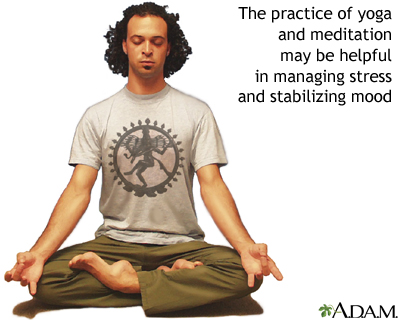
Once a serious cause has been ruled out by your provider, attempt not to pay shut attending to centre palpitations. This may crusade stress. All the same, contact your provider if y'all notice a sudden increase or a change in them.
If you lot have never had heart palpitations before, encounter your provider.
Telephone call 911 or the local emergency number if you have:
- Loss of alertness (consciousness)
- Chest pain
- Shortness of breath
- Unusual sweating
- Dizziness or lightheadedness
Call your provider right abroad if:
- Yous ofttimes feel extra heartbeats (more than 6 per minute or coming in groups of 3 or more).
- You take risk factors for heart disease, such as high cholesterol, diabetes, or high blood pressure.
- You have new or dissimilar center palpitations.
- Your pulse is more than 100 beats per infinitesimal (without exercise, anxiety, or fever).
- You have related symptoms, such every bit chest pain, shortness of jiff, feeling faint, or loss of consciousness.
Your provider will examine you and inquire questions well-nigh your medical history and symptoms.
You may be asked:
- Do you feel skipped or stopped beats?
- Does your middle rate feel slow or fast when you accept the palpitations?
- Do you lot feel a racing, pounding, or fluttering?
- Is at that place a regular or irregular pattern to the unusual heartbeat sensations?
- Did the palpitations begin or end suddenly?
- When do the palpitations occur? In response to reminders of a traumatic outcome? When you are lying down and resting? When yous change your body position? When yous experience emotional?
- Exercise you have any other symptoms?
An electrocardiogram may be done.
If you become to an emergency room, you volition be connected to a center monitor. However, most people with palpitations exercise not demand to go to an emergency room for handling.
If your provider finds you have an abnormal heart rhythm, other tests may be done. This may include:
- Holter monitor for 24 hours, or another heart monitor for 2 weeks or longer
- Echocardiogram
- Electrophysiology study (EPS)
- Coronary angiography
Heartbeat sensations; Irregular heartbeat; Palpitations; Eye pounding or racing
Fang JC, O'Gara PT. History and physical exam: an evidence-based arroyo. In: Zipes DP, Libby P, Bonow RO, Mann DL, Tomaselli GF, Braunwald East, eds. Braunwald's Heart Affliction: A Textbook of Cardiovascular Medicine. 11th ed. Philadelphia, PA: Elsevier; 2019:chap 10.
Miller JM, Tomaselli GF, Zipes DP. Diagnosis of cardiac arrhythmias. In: Zipes DP, Libby P, Bonow RO, Mann DL, Tomaselli, GF, Braunwald Due east, eds. Braunwald's Heart Disease: A Textbook of Cardiovascular Medicine. 11th ed. Philadelphia, PA: Elsevier; 2019:chap 35.
Olgin JE. Approach to the patient with suspected arrhythmia. In: Goldman 50, Schafer AI, eds. Goldman-Cecil Medicine. 26th ed. Philadelphia, PA: Elsevier; 2020:chap 56.
Updated by: David C. Dugdale, Three, MD, Professor of Medicine, Division of Full general Medicine, Department of Medicine, University of Washington School of Medicine. Also reviewed past David Zieve, MD, MHA, Medical Director, Brenda Conaway, Editorial Director, and the A.D.A.K. Editorial team.
buchananhoung1994.blogspot.com
Source: https://medlineplus.gov/ency/article/003081.htm
0 Response to "I Know You Hear the Music Getting Louder Nowthe Fear Your Heart Beat Is Beating Faster Now"
Post a Comment