prior to james madison, what did political theorists believe about democracy?
James Madison, Founding Father, builder of the Constitution, and fourth President of the United States, was born on March 16, 1751 at his mother'due south home in Port Conway, Virginia, on the Rappahannock River near Fredericksburg. His parents—Nelly Conway Madison and James Madison, Sr.—couldn't have known that their eldest child would take a major part in shaping the collection of British colonies they currently inhabited into a nation that would ultimately become a global superpower.
The Madisons lived in a relatively pocket-sized plantation firm called Mount Pleasant in Orange County, Virginia during James Madison, Jr.'s young babyhood. In the early on 1760s, the plantation's enslaved labor force synthetic a brick Georgian structure a half-mile abroad, and the Madisons moved into this house, subsequently renaming the estate "Montpelier."
A naturally curious and studious kid, James Madison likely began his education at home under his mother. He was the oldest of 12 children, although only seven would alive to adulthood, and every bit the eldest son of a wealthy Virginia planter, Madison had a number of privileges that would allow him to hone his inquisitive mind. A distinguished Scottish teacher named Donald Robertson instructed young "Jemmy" between the ages of 11 and xvi at his schoolhouse in King and Queen County. There, the eager educatee discovered a fascination for an array of subjects, including mathematics, geography, and both modern and classical languages, particularly Latin. His power to dive deeply into ancient philosophy built a foundation for the futurity statesman'south influential ideas.
After some further preparatory report dorsum at Montpelier under the Reverend Thomas Martin, James Madison chose to pursue his higher education at the College of New Jersey, which would later be known as Princeton University. Most prominent young Virginians, such every bit his future mentor and friend Thomas Jefferson, attended the College of William and Mary. But the Virginia college's humid, coastal clime was idea to be detrimental to Madison's health, so due north he went.
In 1771, Madison graduated with high marks in classical languages, mathematics, rhetoric, geography, and philosophy. Non satisfied with just those subjects, he became the college's offset graduate student, studying Hebrew and political philosophy nether university president John Witherspoon, after a signer of the Announcement of Independence.
A Political Crusader and Natural Diplomat
James Madison was unsure what to choose as a vocation when he came home to Montpelier. In hindsight, a transition into politics seemed inevitable for Madison, who took a keen involvement in the ways governments functioned—peculiarly the struggle betwixt the American colonies and Neat Uk. He started local, equally a member of the Orange Canton Commission of Safety in 1774, before being elected to the Virginia legislature in 1776.
There, he began forming ties with Jefferson. The ii would piece of work closely in 1779, when Jefferson became Governor of Virginia and Madison served on the Governor's Quango. Madison next served in the Continental Congress from 1780 to 1783, gaining a reputation for thoroughly considered arguments and for bringing multiple interests together in coalitions.
By the fourth dimension he moved dorsum to Virginia to serve a 2d term in the legislature, Madison felt uneasy with the style that country governments were operating. He saw state legislatures as pandering too much to the whims of their constituents, rather than taking a more holistic view. Equally a result of this "excessive republic," there was unrest in many corners of the new country.
Madison did much of his inquiry and writing at Montpelier.
The Father of the Constitution
With a largely powerless primal authorities, 13 state governments passing too many laws that were rapidly changing and sometimes even unjust, information technology was starting to become clear that the Articles of Confederation, the agreement between the states created after the Revolution, only didn't provide enough structure. The central government couldn't pay its debts, and it couldn't crave the state to contribute their share to comply with federal laws. The great American Experiment was in danger of failing.
In preparation for the 1787 Constitutional Convention, Madison drafted a document known equally the Virginia Programme, which provided the framework for the Constitution of the United States. Madison, then 36, spent the months leading up to the convention in Montpelier'south library, studying many centuries of political philosophy and histories of past attempts at republican forms of government. His programme proposed a key government with three branches that would check and balance each other, keeping any ane branch from wielding too much ability. No such government had always been created before, and Madison had to use all of his diplomatic skill to argue for his position. He also had to accept compromises to ensure that the Convention would produce a Constitution that all the states could have.
The concluding Constitution—of which James Madison rejected being chosen the father, insisting until his death that it was the result of the efforts of many—still needed to be ratified. Madison, forth with Alexander Hamilton and John Jay, penned a series of 85 newspaper manufactures in New York that addressed concerns and detailed how the Constitution would function, helping to sway the American people in favor of the new government. These "Federalist Papers" are nevertheless considered some of the most groundbreaking political philosophy of all time.
Madison returned to Virginia to join its ratifying convention, where he famously debated the great orator and Anti-Federalist Patrick Henry. Forth with the other states, Virginia would go on to ratify the Constitution.
Writer of the Bill of Rights
Initially, James Madison believed that a Bill of Rights was not simply unnecessary, but potentially harmful. If we enumerated some rights simply not others, would it imply that others weren't included? Would a Bill of Rights comport whatsoever weight in the face of a despotic regime anyway?
He ended upwards coming effectually to the thought when it appeared that the Constitution would only exist ratified with the promise of a Bill of Rights. So Madison compiled a listing of xix proposals from the hundreds of suggestions that had come up out of the states' ratification debates. A Congressional committee reworked those suggestions into 12 amendments, 10 of which would continue to be ratified by the states. Instead of becoming amendments worked into the torso of the certificate as Madison had thought, the amendments were added at the end of the Constitution every bit a split Nib of Rights.
Becoming the Madisons
In 1794, a young Quaker widow named Dolley Payne Todd (1768-1849) prepared to run into the esteemed statesman, James Madison at the request of her associate Aaron Burr. She was 26 and had recently lost her hubby and younger son in a xanthous fever epidemic in Philadelphia, where her family had moved from their plantation in Hanover County, Virginia 11 years prior.
Dolley and the 43-year-old Madison married later that year. Because Madison was not a Quaker, she was expelled from the Lodge of Friends later the two were wed at Harewood, the plantation of her sister'due south husband in what is at present West Virginia. Madison would help heighten Dolley's surviving son, John Payne Todd (known as Payne), and the family lived in Philadelphia until 1797 when they returned to Montpelier.
At his father's death in 1801, Madison inherited Montpelier and the 100-plus enslaved African Americans who came with it. Dolley Madison was once again part of a slave-owning family unit, despite the Quaker convictions that inspired her father to emancipate his own slaves after the Revolution.
President James Madison — David Edwin afterwards Thomas Sully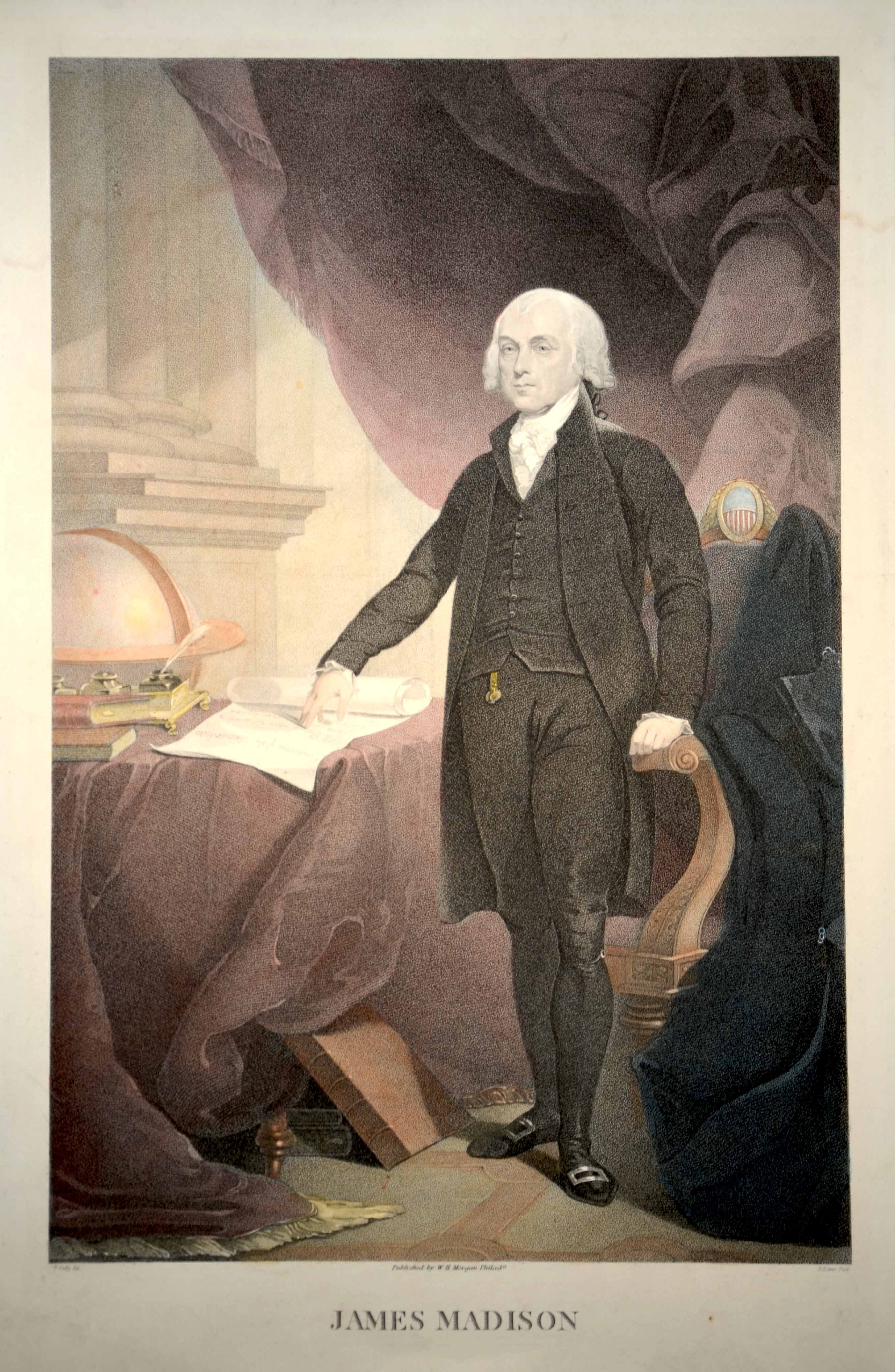
The Madisons Go to Washington
Later serving in the offset four Congresses under the new Constitution, Madison intended to retire from politics altogether, just when his friend and colleague Thomas Jefferson named him Secretarial assistant of State in 1801, the Madisons moved to Washington, D.C., the new nation'due south new capital letter city. During Jefferson'due south assistants, Madison argued for America'southward shipping rights as a neutral party in the state of war betwixt France and Groovy Britain and assisted in applied science the Louisiana Buy.
When Jefferson's time in the White Firm was coming to a close, James Madison was the clear choice for his political party, the Democratic-Republicans.
President and Mrs. Madison
James Madison easily defeated Charles Cotesworth Pinckney, the candidate of the Federalist party, which was chop-chop losing footing. Later on the Madisons moved into the White House in 1809, both Dolley and James began working in their own unique ways to bring about compromises in a Congress that was divided in how information technology wanted to arroyo the ongoing European conflicts. James Madison mollified various political factions in his cabinet member selection, although it left him with a lackluster cabinet that he gradually replaced with more competent individuals. Madison also attempted to balance the demands of Henry Clay's War Hawks, who wanted an immediate state of war with Great United kingdom of great britain and northern ireland.
Similarly, Dolley put all her powers of charm and diplomacy into turning the White House into a place of hospitality, where politicians and their spouses could come up together to accept ceremonious and fifty-fifty pleasant conversations, despite being on opposite sides of an issue. Guided by Dolley Madison's manus, the Executive Mansion achieved a happy medium between the besides-potent protocols of Washington and Adams and the overly-coincidental and male person-dominated gatherings of Jefferson. Visitors to the White Firm felt warmly welcomed in what would become synonymous with the American mode—a not-also-formal environment congenital on respect for each individual guest.
A depiction of the Executive Mansion after information technology was burned during the British invasion of the War of 1812.
A Nation at State of war
Ultimately, the conflict between Napoleon and Britain bled into American waters and onto American soil. Much of the land (and much of Congress) saw U.k.'s actions—impressing American sailors into service and arming Native Americans to attack settlers—as those of a hostile nation, and what was nicknamed the "2nd War of Independence" commenced.
Madison apace realized that the work that he and Jefferson had washed to dismantle the national banking company and oppose a standing army had left the nation largely unprepared for a state of war. Segmented state militias and competing interests made for clumsy initial military efforts. In a motion that shocked America, British troops invaded Washington D.C. and burned the White House. Dolley Madison made the now legendary decision to gild valuables to be taken to prophylactic before the British raided arrived—those valuables included the iconic Gilbert Stuart portrait of George Washington.
The tides turned, and battles on Lake Erie and at Baltimore's Fort McHenry leveled the playing field for the American war machine. When the War of 1812 concluded in February 1815 with the Treaty of Ghent, the ii governments considered it mostly a draw—no territory gained or lost, and no guarantee that American seamen's rights would be respected. But to the American people, it was an of import moment that showed the earth they were not to exist trifled with.
The Madisons at Montpelier
James Madison left Washington with a solid legacy. He made of import inroads in re-establishing the national bank, a working revenue enhancement arrangement, and a standing armed services. The balanced key regime he'd outlined in the Constitution was showtime to prove itself a success.
The Madisons finally retired to Montpelier in 1817 when James was 65 and Dolley was 49. An enthusiastic farmer, Madison applied the best practices he'd researched to raising wheat and tobacco, but conditions, pests, and market prices conspired to keep the plantation's profits depression. Madison's finances were farther strained by the debts racked up by his stepson, John Payne Todd, a gambler and an alcoholic.
Throughout Madison's retirement years, he busied himself with editing his notes from the Constitutional Convention and other papers, equally a gift to posterity and every bit a way to support Dolley after his death, through their publication. Madison worried about the question of slavery likewise, engaging in multiple discussions with esteemed visitors about the possibility of colonizing freed slaves in Africa. While Madison may take considered freeing his own slaves, he decided to leave them to Dolley in his will, with the expressed desire that she non sell them without their consent (a wish she ultimately failed to laurels).
The fourth President of the U.s.a. and the Father of the Constitution and the Bill of Rights died peacefully over his breakfast on June 28, 1836. He is buried in the family cemetery at Montpelier, where Dolley, his married woman of 42 years, eventually joined him.
James Madison's Appreciation Mean solar day
buchananhoung1994.blogspot.com
Source: https://www.montpelier.org/learn/the-life-of-james-madison
0 Response to "prior to james madison, what did political theorists believe about democracy?"
Post a Comment